Showing posts with label Englandia. Show all posts

Friday, January 29, 2016

In Search of the Unknown: Evadne Moon-touched, Part One

Beverly Marshall Saling
Beverly plays Evadne Moon-touched, a character originally created in 1995 for Mike Ryan's AD&D Second Edition campaign. Beverly has updated Evadne a couple times for new rule sets and for the Englandia campaign, this time bringing her under Rob Heinsoo and Jonathan Tweet's 13th Age RPG.

Evadne's a Lelegian Greek, born and raised in Ortygia Grove west of Ephesus. The daughter of a goat herder, Evadne grew up herding, hunting, and exploring her native woods and mountains until she was unexpectedly struck with cyclic moon madness.

At the New Moon, she's brilliant but foolish (intelligence 20, wisdom 8), but at the Full Moon she's wise but stupid (wisdom 20, intelligence 8), and she cycles back and forth. Under the 13th Age rules, this is her One Unique Thing, that she was "gifted" unwilling with this divine favor from the Greek goddess Artemis. Sometimes at the Full Moon she's even possessed by Artemis.

Evadne's Facial Features
Facial Features
(All this requires the GM to track the phases of the moon in his games; fortunately, the Internet is a wonderful place, so finding moon-phase calculators that go back to 1000 CE cures the potential headaches of computing Evadne's intelligence and wisdom on any particular game day.)

There have been other Moon-touched priestesses of Artemis from time to time over the millennia, but never more than one at a time, and never an unwilling one. Artemis sees something special in Evadne, but Evadne is powerfully ambivalent about Her favor. More specifically, her feelings about her calling are cyclic. The wiser she is, the more she loves serving Artemis and is filled with deep intuitions. The smarter she is, the more she hates her service, sometimes in a fey, mischievous, or self-destructive way.

The Change rendered her fit only half the time to herd goats. The other half, when she wasn't making foolish choices, the goats were outsmarting her. Her family found refuge for her in the service of Artemis, where her affliction was revealed to be of divine cause. As the Greeks knew, it's a terrible thing to be a favorite of the gods. She moved to the sacred isle of Delos, where Artemis's priestesses taught her to harness her mental oscillations and to summon the Goddess's powers at need to serve sacred causes, growing into a Goddess-touched priestess and oracle.

Artemis
Artemis
The temple taught her the history of her people, including the millennium of oppression of the Hellenes - first pan-Hellenist domination by the Macedonians, about which the Greeks felt ambivalent, then outright conquest and militarist cosmopolitan domination by the Romans, until Emperor Theodosius I banned pagan religion in 391 and 392, which began a religious struggle that has lasted over half a millennium, continued under the Byzantines since the fall of the Roman Empire.

Evadne's situation under the Byzantines in Englandia is very different from what it would have been in our world. Following the principles Beverly and I established in the late 1990s, Englandia's history deviates from ours in the ways that must inevitably follow if the supernatural and the divine worked for each culture how that culture historically thought it did. This means that, contrary to monotheism's core cosmological principal in our world, in the imaginary game world of Englandia, every ghost and goblin, demigod or goddess, actually does exist more or less in the ways they were believed to.

Evadne's Archery Kit
We made this choice to increase the diversity of factions, monsters, and personalities we have to play with, which makes for a far more entertaining experience. "May you live in interesting times" could be the motto of Englandia - though its imaginary inhabitants might wish otherwise.

In Englandia's history, the Romans and Byzantines never fully eliminated the Olympian religion, because the Olympian deities are real in Englandia. Though the Pagan Greeks were pushed back to the strongholds of their sacred sites, they could not be eliminated, because their deities could neither be disproven as myths nor defeated as mere demons. As actual (well, imaginary) deities, they held their own, and their believers survived down the centuries.

One pattern in Englandia for resolving such clashes is that it's hard on empires. The farther would-be conquerors get from their own centers of magic and sacred places, the weaker their influence. The closer conquerors come to their opposition's sacred places, the fiercer the resistance. So in the world Evadne grew up in, Olympian Greek culture was pushed back but survived.

Zephyr and Zoë and Friend
Zephyr and Zoë and friend
Evadne the Acolyte learned that first the Romans and then the Byzantines - especially during the latter's two periods of iconoclasm - had not only stolen Hellenic territory but also sometimes destroyed, sometimes taken sacred artifacts from her people. Given her unstable affliction, Evadne was never going to be consistent enough to be a temple priestess, so instead she trained in languages, history, geography, and combat - archery, naturally.

Once trained, she set out into the world as an international artifact retriever. Accompanied by her two Hellenic hounds, Zephyr and Zoë, she follows leads from chronicles, folk memories, and legends to guide her toward her people's stolen ancient relics. When she finds them, she "liberates" them and brings them back home to her people's sacred places.

Her current investigation took her farther from home than ever, to the British Isles, first to York to study ancient inscriptions, then up into the wilds of Scotland, north of Hadrian's Wall, tracking 880-year-old traces of the long lost Roman Legio IX Hispana, who her sources say had collected myriad stolen Greek artifacts from around Roman Britannia, hoping to use them in their ill-fated final battle against the Picts. In a decrepit Pictish chronicle, she read accounts of Roman survivors who, instead of wielding those ancient artifacts in a surprise defense of their embattled compatriots, lost heart and fled with them to the Isle of Skye.

Almost a millennium later, she and Zephyr and Zoë follow them to Skye, on the hunt.

Thursday, December 3, 2015

In Search of the Unknown: How the Party Gathers

B1: The party gathers by David Sutherland
In a classic D&D adventure, characters in search of adventure find themselves meeting by chance in an inn or tavern where, listening for rumors and looking for fellow adventurers to join forces with. They simultaneously learn about a potential adventure, find each other, and agree to work together. Time is pressing, the stakes are high, they at once equip themselves and set off to begin their adventures together.

In many ways, In Search of the Unknown is a classic adventure, but this is not one of those ways.

Dungeons and Dragons evolved from wargames, in which the real reason the two sides fought was that the players wanted to have fun together. In the early years of D&D, the characters' motivation was that their players wanted to play. As we gamed together over the years, the theatrical and role-playing side of the game grew, until it became normal to focus on how the world looks from the characters' perspective rather than the players', and modules began to invest more column inches in explaining why the characters joined together and embarked on this expedition.

In Search of the Unknown was an early TSR module. Author Mike Carr developed a backstory for the dungeon and an entertaining table of rumors the players might randomly know about it, but when it came to why these characters per se wanted to get involved with this place, here's all the module has to say:
If all this is true, their hideaway and treasure lie abandoned somewhere in the wilderness, awaiting discovery and exploration. 
Now comes to you a crude map purporting to show the way to their hideaway, a place apparently called “Q.” If it is accurate, it might lead you to the mystical place that was their home and sanctuary. Who knows what riches of wealth and magic might be there for the taking? Yes, the risk is great, but the challenge cannot be ignored. Gathering a few of your fellows, you share the secret and embark in search of the unknown.
B1: Journey into the wilds in search of adventure by David Sutherland

In other words, loot and pillage and excitement!

Later, during the scaremongering of the 1980s, when people made up lies about D&D being a Satanic ritual of some kind, TSR worked hard to revise the D&D narrative to one strictly about the forces of good mustering to face off against the forces of evil. But back when Carr was writing this module, there was an amusingly practical Fafhrd-and-the-Grey-Mouser quality to most D&D adventures.

More than a few reviews of B1 cite this threadbare character motivation as a weakness, but some note what I note: this is an introductory module designed to be customized. It's an adventure template, not an adventure. Each time you run the module, you lay out different monsters, treasures, stories - and motivations. All Carr needed to provide was a generic sample motivation; after the first run-through, even novice DMs could come up with suitable motivations based on how they stocked the module.

I began gaming with the Holmes Dungeons & Dragons set and this module, but I was quickly caught up with everyone else in developing increasingly elaborate premises for adventures and motivations for player characters. In revenge, my players came up with increasingly centrifugal character personalities and goals - self-disintegrating parties.

With Englandia, I turned the tables on them. It's now the players' jobs to come up with characters who want to be together and want to pursue the adventure. This fits well with 13th Age's focus on collaborative storytelling, and it has replaced an old chore with a new delight.

For this module specifically, the players came up with characters so highly motivated that I cut Carr's front-loaded exposition - the dungeon backstory, the rumors - and left the premise of the dungeon a mystery onto which each of the three characters at first projected a different concept, based on their goals and personalities. This added a stronger element of mystery and story-discovery to the module and has lent itself to some amusing discussions and differences of opinion between the player characters, as we shall see.

Tuesday, December 1, 2015

In Search of the Unknown: Setting in Englandia, Islandia, Skye, The Minginish, Dun Merkadale

Pendragon's Caledonia map from Beyond the Wall
Pendragon's Caledonia from Beyond the Wall
As described in "The Road to Englandia," after too many years of studying history, science, and so on, I need my game world to have a lot of verisimilitude and depth to it or I find it unsatisfying, so in 1997 Beverly (my history-major wife) and I settled on the British Isles in the year 1000 as the base setting for my gaming campaigns.

(Extreme verisimilitude is not something I require when I'm a player, just when I'm running games, because the internal coherence makes it much easier for me to think on my feet about what might happen next. As a player, I don't need those crutches, since the character's personality and understanding of the world are all I need to figure out what to do next. I can play in much less grounded worlds than I can run, oddly. YMMV.)

Over the past eighteen years, I filled two bookcases with reference materials to help flesh out my understanding of that time and place (Anglo-Saxon Books has been a godsend). Although some would find this a chore, for me it's a pleasure, since I love to learn and am relieved when the game does not distract me with too many anachronisms—other than those I put there myself on purpose, to advance the fun in the game. As with a poet who writes haikus or other structured poems, I find the structure and limitations imposed by the details of what we know about this setting stimulates my creativity about the many, many things we don't know. They don't call it the Dark Ages for nothing.

For a year I set Englandia adventures in the rural lowlands of Cheshire, but for the following nine years they were south in the Shropshire Highlands, near the border with Wales. I still think of those Shropshire adventures as my main Englandia game, despite not running anything there for eight years. I painted myself into a storytelling corner with too many non-player characters at a Jane-Austen-meets-Beowulf social dance with a lot at stake. Then my nonprofit ate my life, leaving me too few spoons after work to solve the problem, though I've known for years what the solution has to be.

Wikipedia's map of the Hebrides
I still think of those Shropshire adventures as just paused, so for the new and different dungeon-based adventures I planned to start a few years ago (after reigniting with excitement from reading all the wonderful old-school renaissance posts about dungeon design and the mythic underworld) I did not want them to take place anywhere near Shropshire, to reduce the odds of cross-contamination of the adventures.

Looking for isolation, I found it in the far North, which led me to Greg Stafford's marvelous supplement Beyond the Wall, which describes North Britain for his magnificent role-playing game Pendragon. If you're going to do Dark Age historical gaming in the British Isles, you need Pendragon, which is brilliantly constructed, meticulously researched, and beautifully mapped, with gazetteers full of concise place descriptions as stimulating as the best work Judges' Guild ever put out for their Wilderlands of High Fantasy supplements.

My players tend to be a bit disruptive—the Shropshire campaign has so far accidentally set two enormous, angry, warring dragons upon Normandy, which is currently in flames, and refugees are fleeing all over Europe and so unlikely to invade England in another sixty-five years, oops—so even with the help of the physical dimensions of dungeons to constrain them, I wanted to place this new cycle of mythic-underworld adventures someplace isolated even from the isolated places, to limit the damage.

Thus, I turned from the mainland of Scotland and Pictland to the islands, quickly settled on the Hebrides, and dubbed this new cycle of dungeon-based adventures Islandia. After all, the history of the Hebrides at this time was already so disrupted that historians and archaeologists are still struggling to piece it all together, like a dark age within a Dark Age, so those lacunae can cover a lot of player-induced chaos, allowing the mainland of Britain to still stay enough on course to leave me an intuitive baseline to work with for what's happening when the players aren't around.

Some of the first fantasy novels I read as a child were C. S. Lewis's The Voyage of the Dawn Treader and Ursula LeGuin's Earthsea Trilogy, and British Celtic legends are packed with moody seascapes, mysterious islands that come and go, and hollow hills. I could at once see how this setting could greatly enrich gaming in the mythic underworld, inspiring changes in the modules that would make them less generic fantasy, more a unique experience for the players and me.

To avoid cross-contamination from the increasingly epic Shropshire adventures, to create the space needed for these mythic-underworld adventures to develop their own flavor, I also isolated them temporally. The Shropshire cycle had advanced up through 30 June 1001, so I reset the Islandia games back to mid-Spring 1000, before my players upended the table on history.

Campaign map of Skye, based on Wikipedia's topographical map
With the general time and place set, it was time to dial in and place where In Search of the Unknown could best take place.

Of the Hebrides choices, Beyond the Wall's gazetteer described the most adventure material for Skye. Google searches revealed this was no anomaly. Skye is packed with ancient brochs, cairns, duns, ghost villages, and other material ripe for fantasy gaming development, and Skye has a rich tradition of documenting their folklore. It was an embarrassment of riches, so Skye was the obvious choice.

The combination of small population (to avoid the players' disruptive powers being too early inflicted upon a population center), central location, and a pleasant writeup in Beyond the Wall (which we won't be sharing with my players yet, because the details of that gazetteer entry have not yet come into play for the party) led me to the small village of Drynoch on Loch Harport, on the north edge of The Minginish peninsula. Our first game walkthrough, which we'll start in my next post, takes place in what passes for a public house in wee Drynoch. And as a small reference to A Wrinkle in Time—another early read, courtesy of my fourth grade teacher, Helen Yorozu, at Emerson Elementary School in South Seattle—it opens with a blustery, stormy day; anything or anyone might blow into town on such a day, even—gasp—player characters!

I started with some fairly empty maps of Skye to work with, which was fine at first because the players were going to have their hands full dealing with their immediate environs, but after a little over a year of gaming I finally broke down and built the above campaign map of Skye, capturing all the ancient settlements and structures I could. Drynoch's isolation from big (well, "big"; this is Skye, not Yorkshire) population centers in 1001, already evident to me before I built this map, is nicely visualized here. I have no way of knowing if Drynoch existed at all back then, since William the Conqueror's Domesday Book—so useful to my Shropshire adventures—never reached this far north, but that works in our favor, too, since it leaves us free to invent, so long as we retain verisimilitude and internal consistency.

Ordnance Survey map of the vicinity of Drynoch, showing Dun Merkadale
Great Britain's lovely and indispensable Ordnance Survey maps let me scout the immediate environs of Drynoch from the comfort of my home. Even though much has changed in the past thousand fifteen years, it's surprising based on the Domesday Book how much has not. Unlike America, which lost a lot of its history in the Great Plague and subsequent conquest of the Native Americans, Great Britain's history is deep. Wee villages and even the boundaries of fields have in many cases remained stable for twelve hundred years or more, so even a modern map like this is very helpful, when seen after spending years comparing modern Ordnance Survey maps to the Domesday Book.
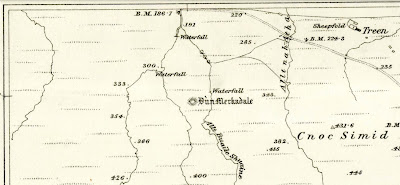
Ordnance Survey Map of Dun Merkadale
In keeping with our haunted-isles-and-hollow-hills theme for the Scottish mythic underworld, I chose the nearest dun—Dun Merkadale as the setting for my take on In Search of the Unknown.

The Ordnance Survey website also includes an option to look at the same location using some of their earliest maps, which date back a century or two. Those maps are much closer to the geography of 1000, with a lovely look and feel, and make valuable gaming references if you're lucky enough to be running games in the British Isles.

For my Shropshire games back in the late 1990s and early 2000s, I ordered both folding and rolled up maps to cover the areas we were gaming in. Seeing the locations of copses, wells, streams, cliffs, and ruins is extremely stimulating to story- and scenario-production when gaming, so it's a good investment if you're going to stick with a setting.

I've not yet made that investment for these adventures based on In Search of the Unknown because the remarkable professionals at Ordnance Survey somehow never got around to mapping the hollow hills and other settings of the mythic underworld with the same level of attention to detail and professionalism they brought to the surface world of mere mortals—and who can blame them, since the lands of the fae are so often difficult to pin down—so for the players' home base and other aboveground needs, captures of online maps are all we need for now.

I'm sure many of you are bemused by the absurd lengths to which I went to choose the setting for a module that originally had almost no description of the surrounding area, but I had good reasons. First, that very absence was noted by several reviewers of the module as a weak spot and was among the reasons Gary Gygax replaced it in the Basic D&D sets with B2 Keep on the Borderlands, because sandbox play is a fun element of D&D but it demands a sandbox, which B1 failed to provide. Second, just as the wells and springs and ruins on the Ordnance Survey maps for the Shropshire Highlands were creatively stimulating, so the details of this choice of settings has already proven very fertile ground for me, as I knew it would. Third, though, as I noted at the outset, for me this is not work; it's fun. There's no right or wrong way to prep your games, so long as you and your players are having a good time. Do what works for you. This works for me.

And so, without further ado, starting next post, we'll begin to recount the tale of Mahdi al-Wali, Sorcha the Urchin, and Evadne Moon-Touched as they venture In Search of the Unknown.

Monday, November 30, 2015

B1E Dun Merkadale: aka B1 In Search of the Unknown

In Search of the Unknown back-cover art by David Sutherland
In Search of the Unknown: David Sutherland's back-cover art
My regular Thursday-night gaming group—Brendan Barr, Eileen Gormly, Kathy Ice, and Beverly Marshall Saling—has been playing in Brendan's 13th Age campaign once a month when Eileen can join us, usually the first Thursday of the month. The remaining Thursdays I've been running them through the classic 1979 Dungeons & Dragons module B1, In Search of the Unknown.

B1's stated purpose is to introduce new dungeon masters to the art of designing and running their own dungeons. Author Mike Carr did the hard work of creating a dungeon—came up with the premise, built the maps, described the rooms, wrote guidance about how to DM, and built tables to help stock the dungeon with monsters and treasure—but deliberately left out the most creative parts for novice DMs to fill in: deciding which monsters and treasures to place where, working out their story, if any, and deciding whether or where to place a boss monster. One of B1's virtues, therefore, is that it's never the same module twice, because the DM's design choices can change everything. Its replay value is excellent.

When I found out my gaming group had never played any classic D&D modules, I knew that I wanted to be the one to introduce them and that this was the one I wanted to start them with. I never run a module the way it was published. I started gaming before there were modules, so building or at least tinkering is second nature to me, and this module is tinker-friendly.

In Englandia, Sutherland's tower becomes a mysterious Scottish broch.
Besides, I have to tinker with any module I run today for three reasons:

1) I've read far too many excellent articles from the Old-School Renaissance about the finest qualities in dungeon design not to want to apply them in my own dungeons. Who wants to play in an underground fortress when you can play in the mythic underworld!

2) Our game group isn't playing original or Holmes D&D, which B1 was written for, but Rob Heinsoo and Jonathan Tweet's 13th Age, which adds intriguing dimensions to the game, some of which I need to prep beforehand.

3) Since April 1997 I have DMed neither generic fantasy settings nor any commercial ones such as Greyhawk, Blackmoor, or Mystara but rather my own homebrew world of Englandia, based on Earth in the year 1000—if the supernatural were real, rare, and worked the way each real-world culture thought it did at the time. For example, instead of generic clerics, thieves, and fighters, Englandia has:

  • a Moon-touched Greek priestess of Artemis with a waxing-waning love-hate relationship with her goddess;
  • an inconspicuous basket-wielding Scottish urchin who only takes things because they call out to her and insist on going with her; and
  • a Persian Sufi demon-hunter traveling the world to free people from demons in the name of Allah the most merciful.

When the setting is this specific, the rules this different, and the mythic-underworld potential this rich, the module is definitely going to go through a transformation.

In this next series of posts at Oaths and Fates, I'll share our party's play sessions, with diversions about the module, the setting, the rules, the Old-School Renaissance, and whatever else strikes my fancy. Since my players are having a blast, they agreed we should share the fun with all y'all.

One caveat: since my players have never been through this module before, I'm not going to explain things they have not encountered or figured out yet, and I ask that you do the same. In Search of the Unknown is known for its mysteries and surprises, so let's ensure these players get to enjoy them.

Saturday, April 10, 2010

Englandia History: Romans versus Druids

The Emperor Claudius's imperial designs on the British Isles turn out somewhat differently in Englandia.

Here's the first of three major changes to British history in Englandia:

The province of Britannia was incredibly important to the Roman empire. The Roman occupation changed Britain forever, but Rome never fully conquered the British, just enough to break the back of druidic power forever. Indeed, there is much reason to conclude that was the primary motivation behind the conquest of Britain was to stop the British from supporting the Celtic resistance on the continent, that destroying the British stronghold on Anglesey drove the shape of the conquest.

The problem is, breaking the druidic line in 60 CE destroyed some marvelous cultural complexity that I would rather have had to enrich my campaign in 1000. To recover it, I would have to find a tipping point in the Roman conquest that would have allowed the druids to survive until Emperor Honorius in 410 declined to defend Britannia (Rome was busy getting sacked by the Visigoths), effectively letting the province go its own way. Fortunately, finding what I needed was easy, inevitable, because all of Britannia already was a tipping point for the Roman empire.

The Romans never even tried to conquer Ireland, and they tried but failed to conquer Scotland, after wasting enormous expense and manpower: abandoning the Antonine Wall after 160 and losing 50,000 Roman soldiers to successful Scottish guerilla tactics during the rein of Septimus Severus.

The evidence is clear: the Romans wanted to complete the conquest, they needed to—failure to do so cost them dearly in military expenditures—but they couldn't simultaneously hang onto the rest of the empire and also finish the conquest of Britain. Rome was at its limit in Britain. Shifting that limit backward to prevent the destruction of Anglesey would not have taken much of a change.

The question for Englandia is whether the shift in the supernatural world—in supernature—would have been enough to bring that about.

On the con side of the argument, a real supernature along the lines planned for Englandia would have been great for Rome. A martial culture that revered Mars, God of War, would have found that a real Mars would have loved them, too, and his favors would have made Rome even more devastating in battle—and that's just one important god out of a vast pantheon who would have taken care of the Romans. For all the parts of life that fall between the domains of those great gods, imagine lares, penates, and genii filling up Rome with intelligence and concern, helping out in myriad little ways to keep every Roman on the path to success and out of trouble. Then, too, augurs and auspices, signs and portents, diviners and oracles, which the Romans so cherished and believed in, would have helped Rome immensely if they had been real, if they actually could foretell the consequences of their plans; imagine how many disasters they could have avoided.

Englandia's supernature would make the Roman empire and every individual Roman citizen staggeringly more formidable.

Unfortunately for Rome, there is also a pro side of the argument. In a nutshell, Rome is outnumbered; Rome is one culture trying to conquer dozens of others, and every one of those cultures also benefits from Englandia's supernature. It's one supernature against dozens of others. The further a supernatural Rome expands the more supernatural enemies it makes, just like in real history and with the same consequences, more or less.

Not exactly like real history, though. Some things would change. The intensity of the struggles would increase and acquire their new, supernatural dimensions. This would shift the texture of conquest and resistance—some cultures that had resisted Rome well would do less well against a supernatural Rome, and conversely some that fared badly would stop Rome in its tracks because of this new dimension to their struggles. Based on design principle two from last post, the crucial variable would be which cultures had the poorest supernatural traditions and which the richest.

Which brings us to the British Isles.

The British mythology was as rich as the Roman. The land would be crawling with monsters of every variety. Every Celtic subculture in the British Isles had its greater gods and goddesses, and the lesser deities would be in every well, grove, and spring, in every venerated place in Britain—and almost every place in Britain was venerated.

As for magic use, this is one place the British would have an edge. Mediterranean conceptions of magic involved mostly nonmagical, heroic mortals interacting with supernatural forces and beings, but the British conception of magic was very different. The British supernatural extended into the lives of mortals. Sure, only a few would be mighty druids and witches, but even the many had their formidable gesas, talents, and second sights. Anyone familiar with Celtic mythology knows a gesa can make even a "normal" person profoundly mighty (at least until the downside kicks in and destroys his life, but hey, that's the Celts for you), but it's the second sight and related forms of divination that make all the difference.

Many Celtic magics resulted in the ability to foresee the future. Yes, many Roman ones did, too, but this is one ability where being evenly matched favors the otherwise-conquered. The problem for the Romans is simple: as important as their military might was to their imperial conquests, their political savvy was crucially important to their conquests.

Rome, like empires before and after, relied heavily on Divide and Conquer, a strategy that in turn relies upon finding feuding groups and lying to one of them that if they side with you then only their enemies will get conquered. In this way, a people who could have defeated you if united instead split up into small enough groups to beat. Rome used this strategy over and over and conspicuously used it to prevent the warring British tribes from uniting against them and kicking them out of the British Isles.

Divination, real divination, destroys this strategy utterly, because the parties being encouraged to feud with one another can check their divinations to discover that those feuds will result in their conquest, whereas uniting against Rome will result in their being able to kick the Romans out of their homeland. The Britons were mighty warriors and highly effective against the Romans (witness the Lost Legion, among many other examples).

If the Romans couldn't convince the Britons to break into small enough groups, the Romans wouldn't have made as much progress in their conquest of Britain.

So how far would the Romans have got under these conditions? They were still mighty and would have been mightier still, but so would the Britons have been, and their powers of divination would have let them unite against Rome. I'm opting for a conservative interpretation of the results. The Romans would still have pushed into Britain and held territory for an extended amount of time, but they could not have spread so far so permanently. They would have held the lowlands, but could never have permanently conquered any of the highlands or outlying areas.

For example, just as the Romans actually had to abandon the Antonine Wall and fall back to Hadrian's Wall, so under these supernatural conditions they would never have made it as far as building the Antonine Wall, and would have been unable to hold Hadrian's Wall either, falling back further into the Scottish lowlands where they would have built the walls and fortresses they could have held, closer to the center of their power in the southeast.

More importantly, they would not have made so much progress toward the centers of British magical power, where the most mighty magics would have been brought to bear against them. Thus, the more the Romans neared Anglesey (Ynys Mon), center of druidic power in Britain, the more they would have bogged down and failed. Just as the Romans in our world failed to hold Scotland and had to fall back to line of fortifications, so in this fantasy world they would have failed to conquer Wales and would have done likewise. Where Offa many centuries later would have built his dike to hold back Welsh raiders at the Severn River, the Romans will instead build Nero's Wall to hold back the terrifying ancient Welsh.

First change accomplished:

In Englandia, the Romans never defeated the druids.

Sunday, March 21, 2010

Englandia: Two Design Principles

The more I studied history, the more trouble I had with the supernatural, with magic, monsters, and the divine. Although a great source of gaming fun and a powerful tool in the DM's arsenal for expanding the game's horizons, it's hard to avoid the conclusion that almost any magic item or spell from Dungeons & Dragons could have changed the course of history at some time in some place. If the world were a Gygaxian cornucopia of magic items and crawling with monsters, history would not even remotely have unfolded the way it actually did. Likewise, the divine.

No, to run a historically-based campaign, balancing verisimilitude and fantasy correctly would have to become a central goal. This led to my first design principle:

In Englandia, the supernatural is real but rare.

In 1997 when I was designing Englandia, I had been gaming for twenty years, so I knew this principle was going to be a problem for me. I was spoiled by the supernatural glut of my previous campaigns, in which magic was always at hand to spice up an adventure. As I've written before in this blog, I used it too readily, especially in Dagorëa, leaning on it as upon a crutch, and it delayed my ability to create convincing non-player characters by a decade during which I tried to compensate with the wild imagination of my monsters and magicks. I'd come a long way since then, but still, cutting the supernatural back enough in my games to keep the setting remotely related to real history was going to be a real challenge.

The solution lay in the adoption of a second, balancing design principle. As rare as the supernatural had to be to protect the historical integrity of the setting, it would have to be just that much more interesting than it was usually handled, to get every bit as much gaming juice out of it. That is, I would reduce its power to change history, but increase its originality and memorability.

For example, if I eliminated dwarves, elves, gnomes, hobbits, and half-orcs as choices for player-character races, I could compnsate by making human beings that much more interesting. After all, any DM worthy of the name ought to be able to create endlessly interesting player races out of the diversity of humanity: God-fearing Roman Catholic Saxons, enbattled pagan Mercians, heathen Scottish tribesmen, shamanic and tattooed Picts, headhunting Irishmen on chariots, fatalistic Northmen in long ships, sullen and xenophobic fenfolk, devout and cosmopolitan Moors, and so many more.

So that's how I would pump up my diminished supernatural, too, how the second design principle would work:

In Englandia, the supernatural varies culturally; it works the way each culture believed it did, most strongly in that culture's homeland.

So, for example, though there would be very few magic-users in Englandia, they would be extraordinarily different from one another, maybe between one and three wizards per culture to represent the range of magic in that culture. Likewise the monsters: from selkies on the Scottish coasts, to waterhorses and loch monsters in Scotland proper, to redcaps on the Scottish borders, on down to pagan Mercia where night stalkers haunted the land, to Christian Wessex with its demons and hags, and beyond.

Common throughout the British Isles was the belief that such things were disruptions, intrusions from the land of the dead, the otherworld, the faerie lands, and so I could set aside D&D's armies of undifferentiated humanoids and replace them with highly individualized beasties crossing over from beyond, each one carrying more meaning than just itself because it also represented a breakdown in the natural order of things, some unique kind of corruption that also had to be addressed.

Beverly and I already knew this was going to be fun. Even just the choice of setting combined with these two design principles was enough to solve many of the problems I'd had with my previous campaign worlds. The more we talked about these ideas, the more I could feel my creative juices flowing again. What a relief!

Still, we couldn't help feel some regrets. The price of finding a historical backwater and all the freedom that entailed was giving up some diversity, a cost we felt more keenly the more we designed a supernatural that flourished and unfolded ever more beautifully the more cultural diversity it had to work with. What we wouldn't give to be able to use fabled Baghdad, crossroads of the old world, as our setting, but its history was just too well documented and too foundational for the course of world history.

The solution, though, lay in those two design principles. The world so made not only thrived on diversity, it increased it, creating a feedback loop. The supernatural is inherently destabilizing to history, and so could increase its diversity, but also, as shaped by the second principle it could stabilize history by surprising would-be conquerors far from home.

Beverly and I studied British history in detail as we never had before to find the delicate turning points, the places where the application of these two design principles would surely have changed the course of history, searching for the fewest number of changes we could make—to keep history close to its actual course—that would both follow inevitably from those design principles and also increase the cultural diversity of the British isles in the year 1000.

Between April and September of 1997 we settled on just three changes to British history that would help to illustrate those principles and shape the character of Englandia.

Saturday, February 6, 2010

The Road to Englandia

Englandia, my fourth and ongoing D&D campaign world, is my current recipe for a fun campaign setting to run.

My ravenous studies in science, history, sociology, and anthropology satisfied my drive to learn but left me unable to enjoy either the random fantasies of my first childhood campaign world or the arbitrarily organized and highly derivative fantasies of Dagorëa, my second campaign world. Both originality and intense verisimilitude have become necessary ingredients in my fantasy play.

However, six years of developing and running Nia Revo, my extremely detailed and original third campaign world, was enough to teach me that inventing a reality from scratch is more work than fun. After three years of running games there, from 1989 to 1992, the increasing intensity of my work life reduced my free time and energy too much to support both running games and the necessary investment in inventing their reality, so I gave up active gaming and spent the last three years of Nia Revo building a notebook detailing its physics, languages, writing systems, history, etc. That turned into an expectations trap, in which the more time and energy I put into the development of the game without actually playing, the more impossible it became to justify all that investment. By 1995 I was burned out and had forgotten how to have fun.

It was clear we had to try something else.

Fortunately, that was the summer Mike Ryan interviewed with Beverly to work for Wizards of the Coast as an editor for the game Magic: The Gathering. Mike liked to DM, so for two years I played and did not DM. Those two years rekindled my love of the game and gave my DMing muscles some time off. Playing in Mike's game taught me that I can't DM unless I play, that the fun of play helps me enjoy life and makes me more playful, and that the tensions and irritations of play stimulate my creativity.

I thought back over my life and realized that D&D was the fountain of my creativity. I learned to draw better for D&D. I learned to write better for D&D. I learned cartography, linguistics, calendars, architecture, geography, storytelling, psychology, and dozens of other things to improve my D&D games. And it worked. My adult games were so much more interesting to me and my players than those of my childhood.

So.

After Mike's game ended in 1996, Beverly and I talked about the rundown of Nia Revo and the lesson I learned from playing with Mike, that I needed to play and DM—that I needed to play to be able to DM—and that I was a better and happier person for doing both.

We talked about the tension between my need for verisimilitude and my need to have the work of DMing be manageable, to fit within our crazy work lives. The limited free time in our schedules meant I had to give up on achieving fantasy realism by inventing it.

Instead, we decided to borrow it.

From history.

Because ultimately, no matter how good I am at simulating history and geography, the results will never be as realistic as reality itself. In hindsight it's obvious, but it took me about twenty years of gaming to relent and admit it to myself.

So over dinner one night in April of 1997, Beverly and I talked through the range of options for when and where to set a new historical campaign. We needed an era that had a lot of interesting cultural diversity, intensity, and turmoil, a time that had a lot of historical material to work with, but a place that didn't, a place where the historical record was sparse enough that we could embroider without unraveling it.

As students of history, we knew that during the Dark Ages the Arab world was the dazzling place to be—and China, the Americas, and many other places were also historically rich and marvelous—but that Europe was a poorly documented cultural backwater, some places more than others. Case in point, from the time the Romans left until the Conqueror's scribes compiled the Domesday Book lie six hundred years only sketchily documented by some chronicles, law codes, deeds, legal documentation, and so on—a lovely but tattered weave on which to embroider our little revels.

And so it was we settled on Saxons and Celts and Picts, Vikings and Magyars and Moors, a series of adventures set on the British Isles starting January 1st, 1000. I named it Englandia in honor of Alfred the Great's lifework and in echo of Jean Sibelius's masterful anthem.

. . .

I never realized it before researching this blog, but Englandia may well never have come about were it not for Mike's fun and fascinating 1995–6 D&D game with us, which rekindled my love of the game. He's like Englandia's godfather, and he was one of its first players. Thanks, man.